Expedition With Jones
Antique late Edo/Meiji period Japanese Carved Ivory Inro & Ojime | Signed.
Antique late Edo/Meiji period Japanese Carved Ivory Inro & Ojime | Signed.
Couldn't load pickup availability
RARE FIND — Antique late Edo/Meiji period Japanese Carved Ivory Inro & Ojime | Signed.
A truly captivating little treasure from old Japan!
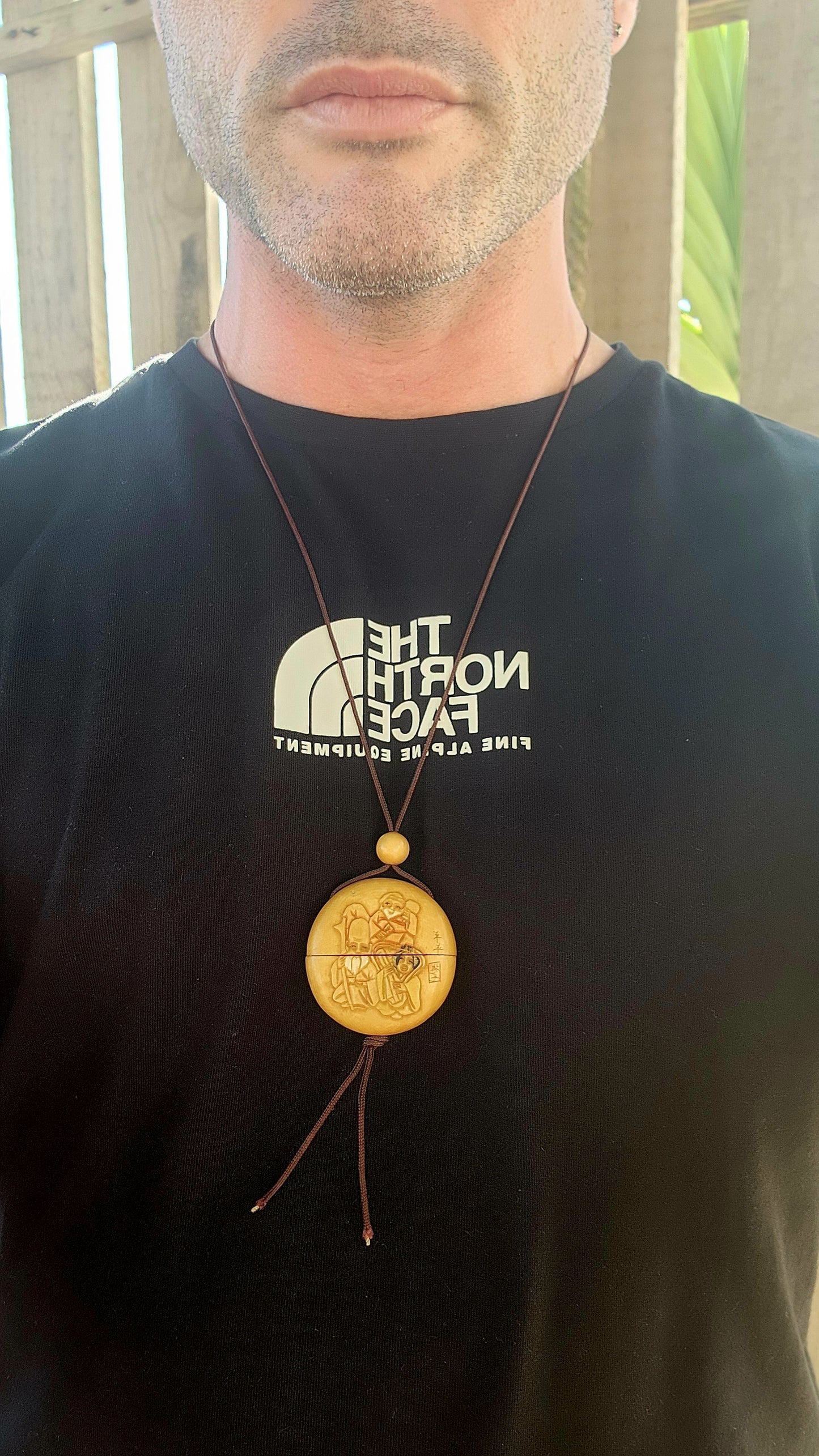
Presented here is an authentic antique Japanese inro keepsake holder, complete with its original ojime slider bead, both beautifully hand-carved from pre-ban ivory and suspended from a traditional brown woven silk cord for wear around the neck.
This round two-part inro displays expert low-relief carving depicting three wise, benevolent elders — likely representing figures from the Taoist/Japanese Daoist Immortals tradition, symbols of long life, protection, and good fortune. Their expressive faces, flowing robes, and symbolic accessories are rendered with warm, time-worn patina and elegant detail.
To one side, a pair of hand-brushed kanji characters and a red artist’s seal mark identify the signature of the maker, adding great aesthetic and historical value.
The small spherical ojime bead, also carved from ivory, functions as a sliding tension bead to keep the inro closed and secured during wear — just as originally intended.
The inro opens at the equator to reveal a shallow inner cavity originally intended to hold small personal items, medicines, perfumed herbal powders, calligraphy seals, or charms.
The inro (印籠) is a traditional Japanese personal container used from the Edo period (1603–1868) onward.
Because traditional kimono lacked pockets, men and women wore small containers suspended from the obi sash. The inro became the most elegant and collectible of these accessories.
Historically, an inro consisted of stacked small compartments held together by a cord. It was secured by:
1. Netsuke (toggle) at the top, keeping the cord from slipping through the obi
2. Ojime (bead) which slides to lock the compartments closed.
Comparable small ivory inro from the late Edo–Meiji era (19th c.) can retail anywhere from R4,000 – R15,000+ depending on workmanship, material, and signature.
Measurements : The inro measures 4.5cm in diameter and weight of 35grams.
Share